Medillustrate
The Art of Science
Rebecca Mellema
SCIENCE COMMUNICATOR
📍 Seattle, Washington, USA
Dr. Rebecca Mellema is a microbiologist and science communicator who brings together scientific research, storytelling, illustration, and animation. With a PhD in Microbiology and Immunology, she uses creative communication to make complex scientific ideas accessible to audiences beyond the laboratory. Whether through writing, visual storytelling, or scientific illustration, her work explores how creativity can transform the way we understand and engage with science.

THE INTERVIEW:
Could you introduce yourself and tell us a little about your background? How did your interests in science and creative writing come together?
My name is Dr. Rebecca Mellema. I have a PhD in Microbiology and Immunology; I worked on platelets in Inflammatory Bowel Disease in Dr. Aaron Petrey’s lab at the University of Utah. I’ve also been a science communicator since 2019, with my focus beginning in scientific writing but has since branched out into illustration and animation. I’m a storyteller at heart; when I’m not writing about science, I’m leading tabletop role playing games or writing my own science fantasy stories (which is very on brand for my blog!). As to how my interests come together, it was more of a happy accident (see question 2) that grew from my love of reading scifi and fantasy. Both genres—especially science fiction—cover a surprising amount of science concepts in them that I wanted to discuss.
You communicate science through a really wide range of mediums, including writing, illustration, animation, and presentations. What drew you to creative science communication, and how did you begin exploring these different forms?
I stumbled into science communication in general during the first year of my PhD training. I began my blog, Getting the Science Write, as just a way to have some fun during the stressful graduate classes. Because I was stressed most of the time from classes and research, I wanted a hobby that let me see the joy in science again. I loved reading scifi/fantasy, so why not try melding science with that? Initially, the blog was meant to just correct the common scientific errors in fiction, but after my mermaid post, I realized I had so much more fun speculating how real science would work in fantasy rather than just pointing out scientific errors.
It turns out that I wasn’t treading new ground; there’s a whole niche of science communicators who use fantasy to explain scientific concepts. Over the next six years of my PhD, I would find and connect with science communicators who used “Game of Thrones” to explain weather patterns, or “Dune” to explain drug addiction, or “Dungeons and Dragons” to explain keystone species. Finding this community of science communicators also rekindled my love of theater (due to the amount of improvisation involved in these projects), which then translated into science presentations. As for the illustrations and animations, I took a series of workshops on science illustration during the final year of my PhD. My instructor, Diana Lim, noticed that I had a knack for these illustrations, so she continued teaching me illustration techniques after the series finished. I was very lucky to have such an amazing mentor! (It also helped that I fought to get into the workshops and then showed a lot of interest and passion in learning more complicated techniques as the series went on!)
Animation was a happy accident; I just wanted to see if I could do it. I had recently seen a 2D animation from the creator, DoodlesInTheMembrane, showing organic chemistry problems, and I became inspired by the hydration animations. I watched a lot—and I mean a lot— of tutorials. Then, I replaced the bouncing balls in the tutorials with cells. Suddenly, my novice animation practices could also double as science communication projects. They’re rough, but they’re so much fun to make! As with a lot of my work, I let curiosity drive my projects and my choice of medium to play in.
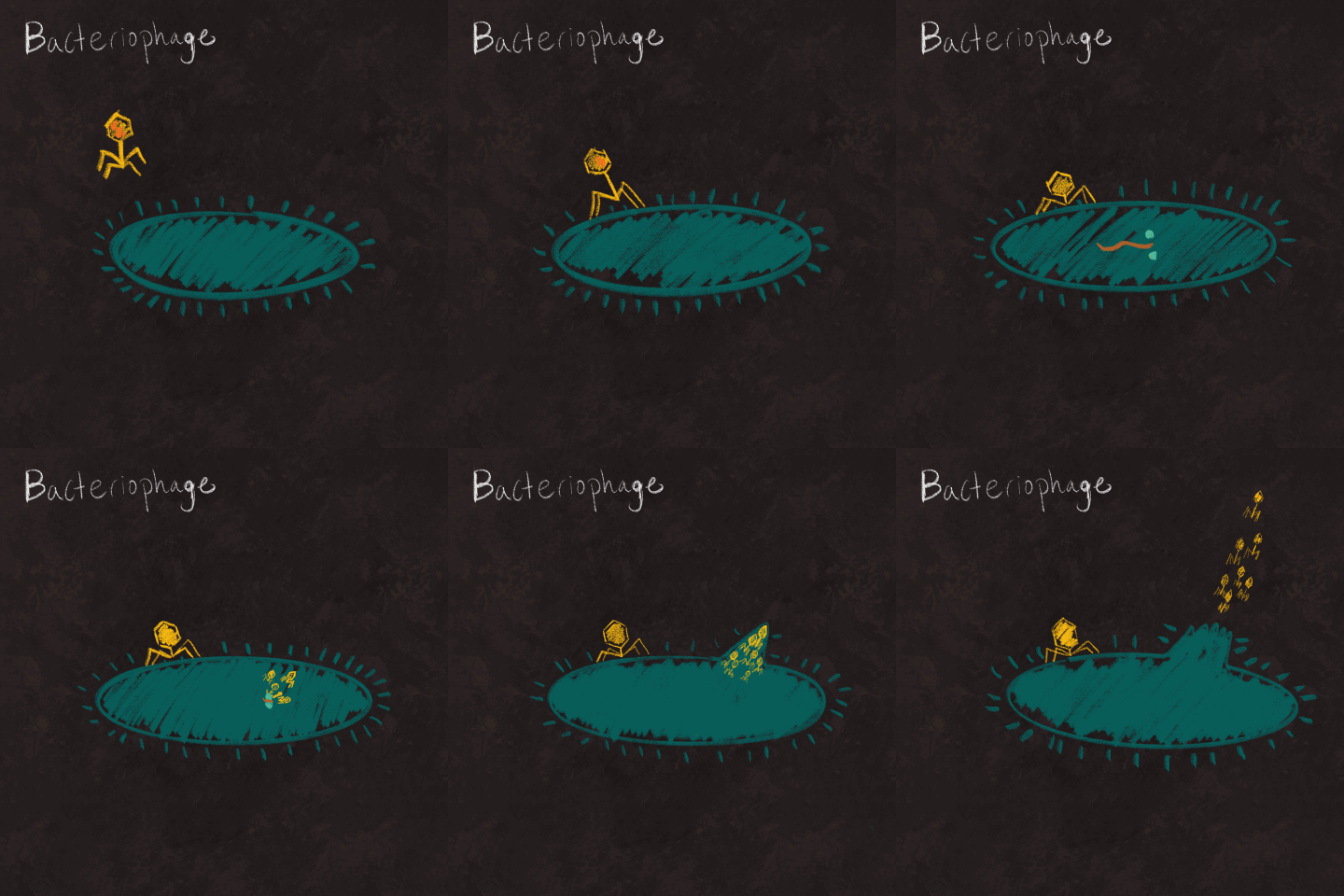
Bacteriophage-Lytic Cycle Animation

Figure 2: The Mechanisms of Layilin Signaling (read her review)
Scientific concepts can be incredibly complex, especially in fields like microbiology and immunology. How do you simplify an idea enough to make it engaging and accessible without sacrificing scientific accuracy?
That’s the never-ending question for any science communicator! Everyone has their own beliefs on how this should be done. To make any science concept engaging, I fall back on my storytelling skills. When it comes to simplifying those same concepts, I happen to have years of tutoring which I can draw from. I have enough experience to see what the simplest form of the concept is and work from there. I strip away any jargon and try to fit the concept in one or two short sentences. If I can do that, then I have the “bare bones” of a science concept I can work with.
I never worry about sacrificing scientific accuracy when simplifying concepts. I think of it like how learning math, where we teach how to add and subtract before they multiply and divide. Or they learn about positive integers before discovering that decimals and negative numbers are a thing. We introduce the crucial building blocks before we add another layer of complexity. To bring it back to communicating science, if I must strip away a concept down to its bare bones, I view that as giving someone their building blocks that we can then build upon later. Like math, we can complicate things later.
Your Getting the Science Write project explores scientific concepts through writing, science fiction, and fantasy. What inspired you to use storytelling and fictional worlds as a way of engaging people with science?
Fictional works have fanbases that like to ponder the logistics of a story’s plot and setting. Most folks who read fantasy and science fiction are already doing what I’m doing—asking how much of our real-world science is feasible in these stories—just without with the PhD. In a way, I’m celebrating my favorite genres like any other fan, though my background allows me to go down rabbit holes that folks would not usually consider, such as asking how much blood a vampire would need to drink in order to meet their caloric needs. That’s not only a fun, wacky question that would tickle any fantasy fan’s fancy, but it’s a question I can answer because I know how to dive into research papers. I’m also a writer myself and have always injected science into my work, whether it be realistic injuries or accurate physics. So, the blog is also very self-serving in the best way possible!
You have also worked to teach scientists how to communicate their research to broader audiences. Why do you think
storytelling and visual communication are so important for scientists themselves?
I have a scientific answer for the importance of visual communication: humans are incredibly visual creatures. We evolved to stand on two legs to optimize our visual field, and the visual cortex takes up almost a third of the brain in primates. It’s our best developed sense, and we scientists should be taking advantage of that at every opportunity. As for why storytelling is so crucial for science, I’m a firm believer that people learn best via stories. Oral storytelling traditions have been around since the start of civilization to pass on information from one generation to the next. It’s a skill every scientist has but often forgets to use when discussing research. Everyone can follow a beginning, then a middle, and then an end; it’s a great format to package information. Even the most complex concepts become less daunting when presented in that familiar structure. Learning storytelling techniques not only helps scientist communicate their research to a general audience, but also to other scientists!


Jellyfish (digital watercolor)
Peacock (digital gouache)
Has your experience as a scientist changed the way you approach art and visual communication, and has creating art or communicating science changed the way you approach scientific research?
I think my PhD training allowed me to use art—be it creative writing, painting, animation—as an outlet, which meant that I was willing to try anything. There was so much joy in being a complete novice in my visual art during graduate
school. Who cared if my subjects were lopsided or the color pallet was off? The act of creating was so much fun and a fantastic way to unwind (especially after a failed experiment). During my PhD, I also dove into improv storytelling via
tabletop roleplaying games, an art form that has zero room for preparation— a stark difference compared to my everyday lab work! In short, being a scientist allowed me to “let loose” when it came to my art (which I still do even after
graduating).
I’m currently not in a lab at this time, but I think the time I’ve spent focusing on my artwork will completely alter how I approach science once I’m back at the bench. I would be more focused on the best ways to visually represent my data
from the first set of experiments (and not scrambling to figure that out once I had a massive amount of raw data to sort through). I would also be the figure-creator for my lab, if they’d let me. I enjoy making graphs look good now!
Are there any scientists, artists, writers, mentors, or experiences that have significantly influenced the way you approach scientific communication?
There are so many! I wouldn’t be a science communicator if it wasn’t for my PI, Dr. Aaron Petrey. He was incredibly supportive of my communication projects during my graduate school, which is not a trait you tend to find in graduate
school mentors. I also need to mention Diana Lim who taught the figure-making I attended in my last year of my PhD. She was the one who took me under her wing and introduced me to the world of scientific illustration.
Shout out to DoodlesInTheMembrane for inspiring me to try animation!
I was also heavily influenced by Dr. Simon Clark’s videos on physics and climate change. His ability to make concepts like atmospheric physics simultaneously entertaining and insightful never fails to impress me! Because I found his work at the beginning of my scicomm career, I was greatly influenced by his style and philosophy of science communication.
What advice would you give to students who love science but also want to pursue creative fields such as art, animation, writing, or storytelling? How can they begin combining those interests?
To all of you scientists wanting to explore an art medium for the first time (animation, writing, etc): make it poorly, but make it.
Your first creations in a new medium will be “bad,” or at least you’ll perceive it as “bad.” I place the word in quotations because the whole point of art is the creative process; as long as you’re finding some joy in making the art, there’s no “bad” art. There’s “poorly made” art, but that’s not synonymous with “bad.” Why?
Because people can still adore poorly made art. No one hates poorly made art. In fact, with the rise of genAI slop, people find poorly made art endearing. The more you create and “make art poorly,” the more refined your work will become and the more those “rough edges” you once despised will become part of your distinct style.
Now, I know that I’m speaking as if you’re intending to share your art with the world. I’ll also tell you that you do not need to document your artistic journey; you can just make art for you. I do that all the time. I have so many short stories and watercolor paintings that are for my eyes alone. These art pieces are poorly made, but they’re made. They exist. I can get better later. Don’t let perfectionism get in your way.
As for how to combine your interests with art? Be a scientist and start experimenting! Do you like needlework and microscopy? Try embroidering stained cells. Do you enjoy baking and biochemistry? Try making doughnuts that link up to make benzene rings. Experiment with your meshed interests. Remember, nothing you make must be perfect.
Make it poorly, but make it.
WEBSITE:
Learn more about
Rebecca Mellema
INSTAGRAM: