Medillustrate
The Art of Science
Annie Patterson
BOTANICAL WATERCOLOR ARTIST
📍 Champigny-sur-Veude, France
Annie Patterson is a botanical artist based in the Loire Valley of France, where she grows and collects unusual plants that become the subjects of her paintings. Working primarily in watercolor on paper and vellum, she combines careful observation, botanical accuracy, and contemporary composition to capture plants at different stages of their lives. She is a longtime member of the botanical art community, has exhibited internationally, and received the 2022 Diane Bouchier Award for Excellence in Botanical Art from the American Society of Botanical Artists.

THE INTERVIEW:
Could you introduce yourself and tell us a little about your background? How did you first become interested in both art and the natural world, and what led you toward botanical watercolor.
I was always drawing and making things as a child and I think my fascination for plants began in Singapore where we lived for a few years in the 50’s when I was very young. We would go to the Botanic gardens and see the giant Water lilies and Plumeria/frangipani - I have since tried to grow both here in France, not with great success!
During the early 70's I attended art school followed by a career as a graphic designer for nearly 30 years before deciding it was time to go back to drawing and painting.
I read a magazine article in a waiting room about the Chelsea Physic Garden in London and Botanical illustration and that was it. It sounded perfect for me so I applied for a diploma course there and was accepted.
What is it about plants that continues to inspire you as an artist? Are there particular plants, environments, or characteristics that you especially enjoy painting?
Plants are a never ending source of inspiration, a never ending supply of unique plants for growing and for painting. The more I look at the plant world the more subjects I want to grow. I’ve painted such a wide variety and tend to get obsessed with the current subject or family. At one time it was fritillaria then seaweed, vegetables, cardoons, rare aril iris. Currently its plants with ‘spikes’, l enjoy the challenge of complex structures and thistles certainly test my observation skills.
Your paintings capture both the anatomical details and the delicate beauty of plants. What kinds of research and observation go into understanding a plant before you begin painting it?
I’ll read about characteristics of a plant family and where and what conditions they thrive in so I have some idea of what is an important feature and want I to include. I make quite a lot of fairly quick reference or field studies of the plant, different views and components so I understand how it is 'put together'. I’ll also make several rough layouts for the composition. When I’m happy with the composition I make a more accurate pencil drawing before transferring the outline to archival Hot pressed watercolour paper. Then I'll add more detail in very light pencil and fine lines in paint before adding areas of pale washes of watercolour and defining the light source which is always from one direction. By using light and shade and aerial perspective it gives the subject its 3 dimensional appearance. There is also more detail and contrast in the foreground. This takes many hours, gradually building up the strength of the colours with both washes and very tiny brushstrokes.

.png)
Corn - heirloom varieties, Kuli corn, Striped japonica
Artichokes
Botanical art requires both scientific observation and artistic interpretation. How do you balance accurately representing a plant’s structure and characteristics with creating a beautiful and expressive painting?
Botanical art for a gallery or botanical illustration for a Florilegium/botanic garden are the same process but the composition and what is included is often different. Paintings for a gallery may focus on a single seed or flower, there are no rules, whereas work for a Florilegium requires more scientific information about the characteristics of the whole plant but should still be interesting. I will try and choose a plant that excites me even if it isn’t necessarily pretty but hopefully the end result will be beautiful. Both should be accurate.
When I started, my paintings were much more rigid and formal but gradually you develop your own style and experiment more with scale or just concentrating on one aspect of a plant. It’s always a challenge to come up with an exciting composition to get the audience to really want to look at the subject even if the plant is not something they are attracted to. The painting needs to have impact.
What do you enjoy most about working in watercolor, and what does the medium allow you to communicate about your subjects?
I love watercolour, it can be used to portray every texture, colour and retain transparency. It can give a light and delicate finish as well as deep, dark textures and I can achieve the finest detail where it’s needed.
Has creating botanical art changed the way you notice or appreciate plants and nature in your everyday life?
Definitely, plants in my garden are there because they interest me and not always for their beauty!
Why do you think visual art is such a powerful tool for communicating science?
For me it’s how complex scientific information is explained in a straightforward way.
Are there any artists, scientists, mentors, or experiences that have significantly influenced your work?
So many - Pandora Sellars, Jessica Tcherepnine opened my eyes to more adventurous ways to portray plants.
What advice would you give to students who love both science and art and are interested in finding ways to bring the two together?
Start with the very basics - lots of drawing and observation, colour theory, research and understand the structure of your subject then you can experiment and find your way of expressing the character of the subject.

.png)
Fritillaria pontica - traditional botanical painting (on vellul)
Berkheya cirsifolia
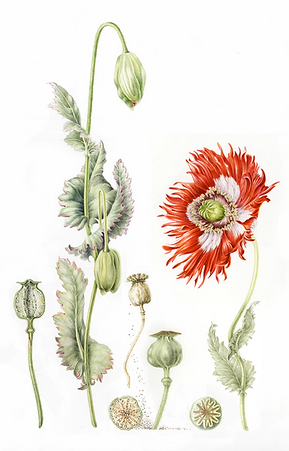
Danish Flag Poppy
.png)
Learn more about
Annie Patterson
WEBSITE:
INSTAGRAM: